Category Archives: Uncategorized

Wait in Emptiness on the Lord

Be glad whenever you give yourself to the emptiness and wait upon the Lord. All our jumping in to the next thing, even in the minutia of eating, watching videos, going out into the world, is mostly a nervousness, an anxiety that drives us to resist the emptiness that’s required to receive the Lord. The ability to open and receive, to empty out, to rest in that surrender. Not know, not do, not even be (in a particular way). That anxiety is what drives people to fill the silence with words, with activity, with knowing, with the bulk of all activity. The ability to gather one’s “resources” of presence into one singular point is advanced. And it takes the ongoing discipline and practice of resting in that moment over and over again. How easy it is to leave the Yes by our habituated modern life! Even when we strive to be as good as possible, there’s still so much more to go. We can have moments when we ‘realize’ the possibility of ‘being’ in that space even whilst engaged in the world but that is pure grace and it’s rare. We can cultivate an affinity, an aptitude but God is who gives us any entry through that narrow gate. It’s far ‘easier’ without the distractions. Learning to fall into the silence amidst the distractions is an edge we can run with but it takes many moons of discipline in the intentional to be ready to receive the grace if/when it comes. Without that preparation, even if it comes, we wouldn’t recognize it.

by dc
September 3, 2022

Our Suffering and the Work of Christ’s Cross

Suffering in Christ we always accept because it halts the world of sin and reverses its effects–it transfers all from a state of separation (sin, spiritual death) to union with God (love, eternal life).

In the moment of suffering, however, we do not have to know anything about this reversal. We do not know our role or how we fit into the greater plan. For this reason, we must endure the suffering with total trust in Christ: he will bring me to the clearing where this dark suffering shows its purpose. Otherwise we could not bear the opaqueness of the horizon, the wall against which our pain and struggle thrusts us. Yet if we can open our hearts to God’s grace, amidst this suffering, the wall turns into God’s light, which attracts us on to our new station in his plan.

In Christ there is more than promise, there is also the pledge that wholeness–of person and of humanity–will be accomplished, by the power of God’s grace, through death. Death is the ultimate symbol and event of our unknowing and powerlessness. But by faith we know this death is united with Jesus. Indeed we bear the dying body of Jesus in us with every step, so we also share in his raising. We carry our cross in following him, trusting that it is the very passage of death that will reveal the wholeness of our life. This resurrection faith necessarily views all temporal suffering in the light of future glory–a glory we prepare to share in by resituating our suffering in this mysterious light.

Provided we sin no more, our daily cross is our participation in Christ’s suffering, which is at every point a suffering of atonement. We witness this in our own lives when our suffering leads us to help and heal others, when it takes it outside of the normal course into the miraculous space of the Gospel encounter.

To bear the confusion of suffering–out of love–allows God to use our confused suffering for his atoning work. He fuses us to him, so long as our heart is discerning of and ready to act on God’s initiative when it comes. This means remaining outward-turned, even when our pain draws us in. The sign for this atoning work is centrally love of neighbor–reproof and aid, education, upbuilding, consolation, reconciliation–, the perfume that wafts from the foot of the Cross.

Whenever we are suffering and confused why, let us therefore entrust ourselves that much more fully to God; and let us open ourselves that much more to encounter and love others, out of obedience to him. Let us recognize in those moments that God is acting to alter the course of the fallen world, albeit in ways that our eyes cannot see. Let us have the courage to live forward into this faith, trusting that he is rerouting our lives through our suffering–that it is his hand guiding us to glory.

This is the new habit of suffering in Christ: to distribute and amplify his halt to sin, his reversal of its effects, and so, washed in the blood of the Lamb, share presently in the saving work of Christ’s Cross.

by Timothy Lavenz
August 18, 2022

Jean-Louis Chrétien’s “Interior Space”

Please follow the link for a translation of the Epilogue from Jean-Louis Chrétien’s 2014 book, L’espace intérieur, Interior Space: https://marianweigh.com/the-christian-topic-translationof-jean-louis-chretien/

chretien l'espace interieur interior space 2

The book is about the self, subjectivity, and interiority. Chrétien wants to show that the modern version of “subjectivity” has lost touch with its origin, its founding moments, which he traces to numerous Christian theologians and mystics. The crucial difference is this: whereas the Freudian “topic” sees an isolated psyche struggling to gain control of its unconscious tendencies and become master of self and world, the Christian “topic” instead focuses on the edification, exploration, and expansion of an interior space in which God may dwell. Of prime importance here is the presence of infinity or alterity that we can “house” within ourselves–whose residence we are. From the chamber of the heart in the Gospel of Matthew to St. Theresa’s Interior Castle, he uses Christian figures to illustrate the energetic, dramatic, and libidinal-economic dynamics at play in the Christian “topic” of interior space (“topic” for topos). Each chapter ends by showing how modern thinkers appropriated and twisted these figures, stripping of them of their God-orientation and tipping them toward the “kingdom of subjectivity.” Chrétien’s aim, however, is not proselytistic but philosophical and schematic: to show the intelligibility of this model of inhabitable personal identity and how it can overcome the impasses in modern thought about subjectivity.

Commentary on Psalm 73

When my heart was embittered
And I was pierced within,
Then I was stupid and ignorant;
I was like an animal before You.
Nevertheless I am continually with You;
You have taken hold of my right hand.
You will guide me with Your plan,
And afterward receive me to glory.

Whom do I have in heaven but You?
And with You, I desire nothing on earth.
My flesh and my heart may fail,
But God is the strength of my heart and my portion forever.

For, behold, those who are far from You will perish;
You have destroyed all those who are unfaithful to You.
But as for me, the nearness of God is good for me;
I have made the Lord God my refuge,
So that I may tell of all Your works.
—Psalm 73:21-28

Commentary by Timothy Lavenz

The psalmist is bitter, he is stupid, arrogant, yes–it’s not as if faith turns you into a perfect person overnight! far from it–but even amidst him being ‘like an animal’, his desire and will is to stay near to God. He has faith that God remains near, even when he is acting such a fool that he can’t feel that nearness. He knows that, although his own trust falters, God’s trustworthiness is perfect and never fading. God will hold good on His promises and, no matter what trial we face, our best option is to remember those promises, recollect ourselves to God, and grow in endurance of this faith.

For the psalmist knows that salvation–which will bring him across the world of anxiety and death–is found in God alone. He is “the strength of my heart and my portion forever.” The psalmist has nothing, wants nothing more than Him–for he knows he is only real and alive where he is in communion with God. He has also had the hard experience that anything not rooted in God will let him down–though yes, the entire world can be, should be and is rooted in God, such that all is a manifestation of His glory! The psalmist knows that anything we do apart from God–apart from the Spirit of Truth and charity, goodness and beauty–lacks reality. It lacks value, lacks consistency, lacks time. As Aquinas put it, “Insofar as we are sinners we fail to be, and are not”–yet as we obey God, we participate in His Being and are.

God alone is imperishable; therefore I am only safe (saved) where I find myself in God–where my soul is in God and God is in my soul. “Apart from Me you can do nothing,” the Son of God tells us in John 15:5. That is why God’s nearness is the good for the psalmist. Then are his eyes opened to praise all God’s works–creation, salvation, and judgment.

The ‘unfaithful’ one, however, does not see things this way. He is far from God. This character has no respect for the Creator. He is ungrateful for his life and lives only according to his own self-will. If we are near to God, we live in accordance with the Law of His Love. The psalms constantly contrast this ideal of holy obedience with the sinner, the wicked, the self-obsessed, the exploitative, the cruel, the murderers, the mockers and despisers of God. Maybe they don’t mock God with blasphemy, but they do mock him by their actions–putting their own designs above God’s, mistreating orphans and foreigners and widows, disrespecting creation in general.

When the psalmist exclaims, “Behold, they perish!”, this is not said in a vindictive or celebratory way, as if happiness came from winning over enemies, or he took pleasure in their destruction. God does not take pleasure in that! This is rather about upholding truth in reality and reckoning with consequences—spiritual physics–and celebrating the fact that God’s justice is real.

In verse 27, the psalmist expresses his confidence in the final reckoning of things–confidence the validity of true judgments. Those who live only for themselves, who do not love neighbor and God–behold, they perish! Behold, they have fame and wealth, status and power, pleasure in worldly things for a while, but because they did not build on a firm foundation, they come to ruin. Their gains are passing shadows, falsehoods. And even if they make it to death without justice being served, still, their life was wasted in nothing, because “Apart from Me you can do nothing.”

Verses 21-22, however, suggest that the psalmist knows he could share the perishers’ fate. That is a very real possibility, for every sinner. Indeed, what could be more of a lie than for a human to stand before God like an animal? The whole issue of ‘faithfulness’ is about not living in a lie. If you live in a lie, you will perish, because all lies perish. What ground could they have? They are doomed fantasies.

The pain of living in falsehood, below one’s dignity, is elegantly captured by those first lines. They summarize our feeling of being abandoned and alone in our weakness. But verse 23, the “nevertheless” of faith asserts itself. Trust triumphs over defeat. The sudden recollection of the bounty of the living Lord dispels all fear. The epiphany is so strong that the psalmist can stand humanly before God, confess his weakness and recommit himself to God. It purifies into ash whatever his bitter heart might have sparked up into falsehood. With praise and active entrustment to God, he is actively putting the very possibility of living in a lie behind him.

To live in a lie is to squander the most precious possession available–a relation in God’s faith. To recognize the unfaithful are destroyed in their lies—that is a wake-up call that will save one’s life.

When God allows us to go through the painful consequences of our misbehavior–lets us be destroyed–this is a manifestation of His mercy. It serves the possibility of our repentance. And it is better to be destroyed by one’s false way and have that chance, than to carry on with nothing stopping it. Experiencing the destructive consequence can be part of the wake-up call one needs to change. The destruction also clears away what is false, so something else can have a chance to breath.

Impress this truth upon your minds, my listener! All falsity, however ‘minor’, brings destruction of the good. And so all falsehood will be destroyed–because there is no falsehood in God and this creation is His. What cause for great rejoicing! But it also puts on display the utter stupidity of giving any ground to lies, deception, falsehood, sin–for it is ground that will have to burn.

God’s forbearance is long, He is “slow to anger, abounding in steadfast love”–but mercy stands in a balance with judgment, which falls hard on the impenitent. But it falls hard on them for their own good. Everything God does is meant to bring us nearer to Him. The moment we understand that, the whole way we look at our suffering changes. We are ready to bear the destructive force of God’s wrath, knowing it is an event of His profuse mercy intended only to provoke us to turn our lives around.

How pleasant it is to meditate on the veracity of God’s judgments! How good to love God and know one’s “everlasting portion” of Him! There is one saved from wickedness forever. There is the peace that “surpasses all understanding.” Praise His love in all its forms! Praise His mercy, which stretches out to us no matter how much we’ve failed or gone astray! So long as we turn back to God, trust in Him, have faith, He is ready to forgive and heal us from everything we squandered in our God-denying ways.

Let us remember Jesus’ first call, which never ceases to call out to our sinful natures: Repent! Look where you’ve put your treasure–that’s where your heart will be! Make sure the light in you is not darkness! Be wise, put your treasure in God! Then you will know that refuge, that everlasting share which does not perish, which remains even when flesh and heart fail.

The Wounded Heart of Jesus and Man’s Spiritual Heart

C. S. Lewis’ claim that Christianity is “the completion, the actualization, the entelechy, of something that has never been wholly absent from the mind of man” could be adjudicated by looking at the core symbols of different religions and then discerning what is unique in Christian symbolism. For example, symbolism of the heart. In the Upanishads and the Bhagavad Gita (10:20, 18:61), it is well attested that God or the Supreme Being resides in the heart. Whether it comes to knowledge-path (Jnana) or devotion-path (Bhakti), it’s by withdrawing mind and senses into this heart-place that God is realized and liberation found (immortality, bliss, peace, etc.). There is no doubt something universal about this in the religious life of man. To find God–permanent, unborn, transcendent, all-pervading–in the seat of intimacy, in the heart-center (hridayam): that is universally attested to be the road to everlasting fulfillment, spiritually-speaking.

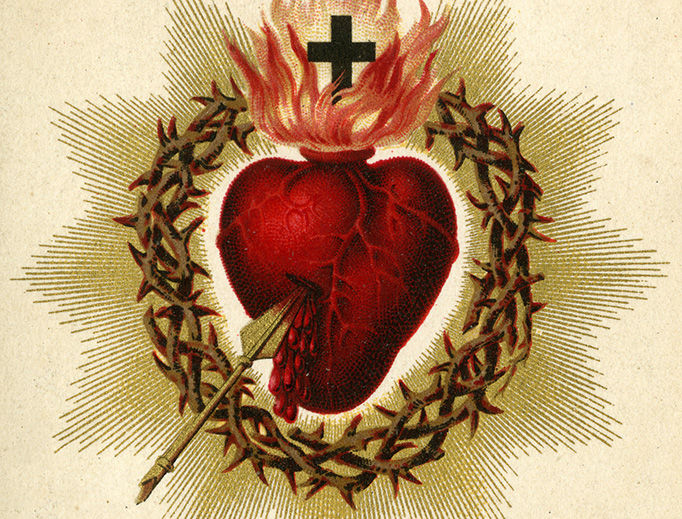
When we look to Christianity, then, what is different? Only the symbol of Sacred Heart–the Wounded Heart. This is a heart that expiates for sin, that bleeds to bring life back to man, that exposes itself on the surface of the body (incarnationally)–as if it wished to reach us through the very intensity of its pumping. It is understood theologically as a symbol for God’s own self-sacrifice out of love of humanity, an act of passionate love-suffering meant to reverse and redeem the effects of sin and separation from God. This bleeding heart is God’s initiative, God’s revelation. And thus it is a picture, not so much of a heart-essence pre-existing in every heart, but a new model of heartedness, the ‘new heart’ of flesh God wishes to transplant into our flesh. It promises “eternal life” with God, but it tells us the road to eternal life is the Cross–not a withdrawing of mind and senses inward, not a realization of Oneness, so much as a foolish expenditure of a heart pouring itself out for all, accepting every humiliation and persecution in imitation of Christ’s own love (Jn 13:34).

On the model of the Suffering Life of the Lord, we reach a new limit of spiritual-physical self-sacrifice, a new symbolic depiction of man’s spiritual heart–it is the image of Crucified Love. In Judaism the ultimate love is expressed in one’s willingness to die in defense of the name of God; here it is transferred to the willingness to die for one’s friend, because God himself lays down his life for his friends. In Buddhism, one undertakes enlightenment for the benefit of all beings, and one even puts off final liberation for their sake; but you’d be hard pressed to say that it advocates a going-to-death out of love for the neighbor, or uses such bloody imagery to do so. At any rate, the Christian’s orientation is not limited to alleviating or escaping suffering; it entails rather a request to suffer, a desire to suffer for Jesus’ sake, to have a share in Christ’s own mission of atoning love-suffering on the Cross.

In the three instances alluded to, we can see what drives those who see in Christianity the fulfillment of other religions. It too places all the emphasis on love, on an awakening of the heart. This is the secret hidden point to which the religious imagination of man is always pointing and which God in the fullness of time has revealed. Still, in this revelation, God shows us something–God does something–that man did not expect. Nowhere do we find this so vividly depicted as in the Crucifixion, the pinnacle exposition of God’s sacrifice for sinners. Blood and water spilling from the pierced side of Jesus: here is a fulfillment yet also a radically new destination for man’s spiritual heart.

It would be up to each individual, however, to discern this mysterious difference and believe it–to see it as as a worthy evolution or genuine culmination. After all, one could always look at the Bleeding Heart of Jesus and think it is an aberration on the universal theme, perhaps like the Jews who went away disgusted when Jesus said, “unless you eat the flesh of the Son of Man and drink his blood, you have no life in you” (Jn 6:53).

Douts, Man of Sorrows

Love’s Verdict and the End of the World

The world has already ended! Time has already come to a halt! Don’t let the media fool you: this age is already over! The things of today have already evaporated into a sparkling eternity where everything temporal is like dust and love alone is kept safe, surviving. Likewise you and I have no chance of survival apart from love: everything we put into the things of the world is already moth-corrupted. Already!

Our life is not measured according to the time of the world, but we move and have our being in love and on love’s watch alone. The ultimate standard of judgment has nothing to do with how the world judges, but how love itself judges us. So what are you doing believing in way the world judges, and avoiding the verdict of love? What are you doing paying attention to smoke when your soul is crying out to be united with the fire itself? What are you doing being fascinated by things you will forget by tomorrow, when the only thing that is not forgotten is the extent of your love? What are you doing drowning in a multiplicity of distractions, when this one thing is needful? Why so guarded, when the heart yearns be opened up? Why so afraid to love?

Because you have been told that it is better to play it safe and follow the rules. Because you have agreed with the masses that however much things suck in the world “that’s just the way it is.” Because you have been trained to put on a mask of happiness and have forgotten how to share all the pain that lies underneath that mask. Because it is suicide to not “save face.” Because you’re told that success has to do with material things or worldly power or social status or physical appearance– that is, with the things that you can accrue for yourself, as if you could take any of these things to the grave. Because they medicate the depressed, ostracize the perceptive, and shun the sensitive, to such an extent that it seems dangerous to even appear as if you are skeptical of their ways. Because you’ve been trained to look at the world’s nonsense as normal, such that anything issuing from elsewhere is strange and uncomfortable– when it is in fact the television itself that is the instrument of terror. Because you’ve been so desensitized that the things that ought to make you weep don’t even make it on to your radar. Because it is easier to shut off; because it is easier to not think; because you know that if you stood back, thought about it, and stopped consenting to the game, the whole edifice would instantly collapse under the weight of its own inanity; and that once that happened, the world would cease to have a use for you and would throw you to the street. That is how little it actually cares for you! But it is easier to consent to stupidity than to feel the scorn of the stupid against you when you refuse them; and you are afraid that if you really thought about how empty the pleasures of this world are, you would be left wondering why you even exist. O wretched age! When will you see that the answer lies outside your fabrications and your delights? When will you see that yours is a culture of ennui and death? When will you accept that you are a worldwide farce and magic-show, not worthy of laughter and applause, but of sorrow and tears? When will you realize that your markee has already gone blank, your news feed already disappeared?

But no matter. There is no excuse for agreeing with anything the world says: it lies to you. There is no excuse for following its ways any longer: they are all unreal, leading to endless boredom, illness, and death. There is not even an excuse for believing the world still exists. Sit quietly for a moment, and ponder how in a very short while all the things that seem important to our generation will pass away, how ages come and go dreaming of their glory but in fact are quickly dismissed. No, there is no excuse for even discussing the passing attractions of this age, for what seems flashy today has already been decaying for ten-thousand years.

Because what actually matters is the suffering of those around you: the ones who the world has rejected as lowlifes and untouchables. What actually matters are those who are too hungry to keep track of the time and the newspapers. What actually matters is the person who is weeping, for whom everything is long over. What actually matters is not what can entertain us or keep us happy. What matters is what we can give to others in need, knowing that very soon we go away to death! Yes, on that day, all distinction in the world proves utterly naught. All that remains for us on that last day is the truth of how we’ve loved.

Prepare for the judgment then, my friends! Prepare for the last day! There is no excuse for you to keep living for yourself! Give it up already! The world has ended!

by Timothy Lavenz
August 3, 2012

Orthodox and Heretic

The heretic wakes up to work on his own ideas. He thinks the road is his own, even if he’s traveling it in service to others. His idiom is self-created, for it is his own voice he crafts when he writes and speaks. His pride, in part, is to undermine what others have accepted as true. He is happy to have obtained a secret knowledge or gnosis as the possession of his struggle. The key to understanding him is independence.

The orthodox wakes up to work with what God has done and is doing. The road belongs to the people God has gathered to himself, with whom he shares responsibility for what is said. The idiom is a mysterious outflowing of Spirit, drawing on the individual’s talents but tested and verified in prayer and by the witness of other holy people throughout time. His happiness is a reality of communio: his joy is in you, your joy in him. The key to understanding him is gratitude.

Continue reading

The One Necessary Thing: Kierkegaard on Human Possibility

Our world is one that glorifies in unlimited possibilities, choices and options, not seeing that most of the time ‘having options’ is just a sign of confusion or uncertainty. Our confusion over ‘who we are’, ‘what to be’ and ‘what to do’ is a sign of our ensarement in this morass of unlimited possibilities. We feel called to ‘choose’, but according to what criterion? One day we follow one criterion, another day we follow another, but they keep on losing their luster. We bounce from attraction to attraction, thinking we might find the right hook, but instead we get hooked and dragged that much further away from ourselves. At the end, all the possibilities and criterion presented to us in this world seem arbitrary, lifeless. None of them sticks, and in our chasing them down we seem to have wasted everything.

Soren Kierkegaard gave the famous name “the sickness unto death” to this fatal escapade into countless possibilities and options that alienates us from ourselves. Worse, the hell of false criteria is so captivating and enslaving that we do not even recognize we are in despair. Many land on some mode of not willing to be themselves to such a degree that they do not even despair of their despair. We come to our mortal end having not become ourselves: the gravest consequence a life could have to face, indeed, a terrible self-damnation.

Boredom is maybe the most obvious form of this sickness: faced with the unfinished and potential quality of our self, we seek to find a distraction from the task of becoming who we are, even knowing our distractions will fail us and make it harder to come back to ourselves. In boredom, we do not will to be ourselves or any self. We stand ourselves up, leave ourselves behind. Lost in an endless string of maybes (‘maybe this will be fun’, ‘maybe this is a good idea’, ‘maybe this will solve the problem’) we never catch on to the One Necessary Thing.

Self-will is another form of the sickness: the wish to transform ourselves according to how we want, to compose our own self. The self pays attention to itself, its own significance and enterprises. It busies itself with imaginary constructions, with a “simulated earnestness.” It sees itself as its own task, its own work of art, its own project of existence to outline in the abyss (we can think of Nietzsche here). It proclaims itself the criteria for filling out its potential — but its criteria is only ever finite, shifting, built on sand. Such a self thinks it is the master of itself, but really it is master over nothing — a fact which brings despair. And yet this nothing is turned into delight, the dead-end legitimized as the virtue of the dead-end path. The self wants to enjoy “the total satisfaction of making itself into itself, of developing itself, of being itself,” yet right when it seems nearest to completion, the whole thing dissolves into air. Self-will and “going to the limits of the possible,” as an existential project, leave us empty.

For Kierkegaard, there is only one decision worth making: take possibility back into the necessary, be aware of oneself and one’s limitations, be stripped of fantastical self-projections and imagined criteria; and so rely on God entirely to give the self its possibility and criterion.

*

What constitutes the self rightly is the power to obey: to bring its finitude under the one criterion of infinitude. That is the one choice, made in prayer: the choice for the eternal in the self, which only the eternal can give. This is where, humanly speaking, there is no possibility left: where the only question is whether or not the person will believe. The believing self has faith that God will give its possibility back to it, for “with God all things are possible.” But the self renounces control over this possibility. It is God who will synthesize the necessities of my life with the possible He makes possible: my contribution to the Kingdom of God.

To “will to be oneself,” for Kierkegaard, is to remain steadfast in this faith. It is to “rest transparently in the power that established” the self, that is, to rest in the eternal and receive our self (and our self-becoming) from God alone.

To switch idioms, Kierkegaard is talking about where finite freedom and infinite freedom coincide, where my finite act and the act of infinite consciousness are one. That is why he speaks of personality as a “synthesis of finitude and infinitude” which manifests an “infinite possibility.” Something of the eternal light shines through us in the light we shine. That light is fueled and empowered by God alone; yet simultaneously, it is a real gift, it is our light.

Philosophically, we can debate what all this means, and we may find other idioms to articulate it more clearly, but the lesson is clear: only by resting transparently (prayerfully) in the transcendent power of being can we ‘choose’ rightly and ‘be’ ourselves, as well as ‘imagine’ and ‘create’ in a manner that is not vain. Only through this rest is the synthesis of possibility and necessity for the self established and achieved. Put otherwise: the self we are tasked with becoming is accomplished by God’s action in us. He alone makes us persons, endowed with the infinite we are to be.

What we should stress here is something quite strange for the modern mind: such resting in God amounts to the elimination of possibilities — the purification of alternate routes and imagined scenarios down to the one necessary thing, which is to believe that with God all things are possible. Again, to repeat Kierkegaard, “the critical decision does not come until a person is brought to his extremity, when, humanly speaking, there is no possibility. Then the question is… whether he will believe” (Sickness unto Death, p 38).

Of course this resting, this belief, is not a matter of inactivity — quite the contrary! Faith is the only real act possible, our only “power” the power to obey. Yet from this faith flows a bounty of activity grounded in God, a living spring of water irrigating our work in the kingdom of heaven, according to God’s will. For when the seed of the Word of God falls on good soil, it produces “a crop a hundred times as great” (Lk 8:8).

*

The one necessary thing (Lk 10:42), then, is to entrust oneself in faith to God the source of being and action, such that God gives the self its act of becoming. This is proper worship in the fullest sense: a participation in the creative cosmos infused by the light of God. Sri Aurobindo would speak here of the soul or “psychic being” governing the physical, vital, and mental levels of our being. Then we possess a clarity bequeathed by the grace of the Divine alone, for we have found that soul-spark within, unified with the Divine. When we are wholly reliant on the eternal in the self, we come “in flow” with the divinization of earth, the sanctification of the cosmos. We catch a foretaste of the transfiguration of created being into light. Our path and the work we have to do then is “sure,” not because we have in mind the right plan to execute, but “sure” through the earnestness, thoroughness, and steadfastness of our entrustment to God. We are “sure” — trustworthy — because we have eliminated every other possibility and taken the criterion of God’s infinitude as our own and only one.

Kierkegaard’s point in talking about “becoming a self” is that once we commit to say Yes to God — and resolve to commit ourselves to it repeatedly in faith, that is: we vigilantly will to be ourselves as God wills — the course of our life takes on a direction that progressively eradicates choices and the imagining of any other possibility (all of which pale in comparison to Christ). We have to discern here a total surrender which places the entire fact of the future in God’s hands, an obedience to the infinite grounding power that consents to let finitude be shaped entirely at God’s hand. This is to live into the Mystery such that there is no confusion or option left, but only the peace, boldness and clarity that comes from saying, thinking, and enacting the Yes to God.

Finally, we can think about the Incarnation in these terms. As wholly divine, Christ did not have ‘potentiality’ like we do. He did not have options or things to choose on his own. “The Son can do nothing of himself, but what he sees the Father doing.” “I have come not to do my own will, but the will of Him who sent me.” Jesus’ earthly being and will are a pure act of obedience to God’s heavenly being and will. For Jesus, not a single moment went by that His action was not unified with the actus purus of God (classically speaking, there is no potentiality in God). All of his human ‘potential’ was given over to the unum necessarium: love and obedience to God, bearing a superabundance of fruit. Christ manifests in fullness what Kierkegaard calls “infinite possibility,” for in him the humanly possible and the holy possible are perfectly united. God’s synthesis of finitude and infinitude, human and divine will, shines before us in all its glory in Jesus Christ, the “light of the world” (Jn 8:12) and “light unto the nations” (Is 59:6), “the light shining in the darkness” that the darkness has not put out (Jn 1:5).

by Timothy Lavenz
July 12-13, 2022

Creation is “Very Good”: Buddhism and Vedanta seen in light of Christianity

I

In my own journey of faith, I have discerned two fundamental differences between Buddhism and Vedanta, which I treat here as emblematic of Indian/Eastern Spirituality, and Christianity:

  1. The East predominately teaches that this world is illusory and of suffering, whereas Christianity teaches that God’s creation is “very good” and filled with God’s glory; it is endowed with its own laws of development and dynamics of freedom such that it is both different from God and of God.
  2. The East predominately teaches that individual selfhood or personhood is illusory and false, whereas Christianity teaches that the human person is an ontological reality; and that love between persons is grounded in God, indeed, at its best, it reflects the exchange of love between the three Persons at the heart of Trinity.

Buddhism teaches the doctrine that everything is empty of inherent essence or substance (śūnyatā), and that the self is a convention we project upon what is really just a passing collection of aggregates (skandhas). Through meditation on the codependent arising of all things (pratītyasamutpāda), its goal is to enlighten us to the emptiness of the self, its desires and the objects of the world. Then, through compassionate action for all beings, as expressed in the Bodhisattva vow, we are to help others realize this emptiness, too.

Advaita Vedanta teaches the doctrine that the world is an illusion (Maya) without any existence apart from Ultimate Reality (Brahman); and that the small self (jiva) with its desires, memories, and attachments to body and mind is a false limitation on the true Self (Atman). The Upanishads instruct us to realize our true identity as Brahman and be liberated while living (jivanmukta). The world, the realm of change and decay, which is falsely “superimposed” (adhyasa) upon true reality, should be “desuperimposed,” so that instead of seeing the snake in fear (Maya) we see the rope in bliss (Brahman).

Now whether one denies any self (anatta) or affirms the Self (Atman), in both cases what Christianity calls the person (hypostasis) is not treated as a valuable reality in its own right, in itself. The self is treated at best as a conventional reality, a projection upon aggregates or a limitation of the limitless that has no reality in ultimate reality. The limitless may be termed “Pure Mind” or “Light Body” or “Satchitananda,” but the relations are clear: embodied personhood is false in comparison to it, and spiritual practice is meant to rid us of the falsehood. Likewise, whether one treats the world as empty or as a dualistic delusion, in both cases it is not treated as a reality worth saving.

Of course I have vastly simplified matters here, and any scholar would surely wish to complicate this picture. And I know my simplification risks offending affiliates of these schools. I can only ask the reader to contemplate what I say, trusting that I have investigated these claims in good faith, practiced these spiritualities and wrestled with their consequences, and come to this conclusion which I now present in condensed form:

I do not believe it is possible for any human person to live strictly according to the anti-personhood and anti-world doctrines. They may say that’s what they’re doing, but in reality, at their best, they are anonymous Christians. In their moral behavior, in their pursuit of the truth, in their respect for the beauty of created things, in their self-sacrifice for others, they implicitly affirm the value of persons and the value of action in the created world.

II

Before enlightenment, duality puts you in delusion.
After enlightenment, a duality imagined for the sake of love, Bhakti,
is more beautiful than non-duality.

I find this statement from the magnificent Swami Sarvapriyananda very telling. The core insight of Advaita Vedanta is “Thou art that” (Tat Tvam Asi). Not your mind, with its memories and thoughts, nor your body, with its birth, age, sickness, and death, but you as the pure witness-consciousness of all this (sākṣī), “you” are ultimate reality itself: Atman is Brahman. That is the path of knowledge, Jnani, perhaps best exemplified in the modern era by Ramana Maharshi.

But when the Swami confesses that love is more beautiful than knowledge, he also avers that the I-Thou relationship — once purified of the dross of ego, illusory self-will and falsehood — is more beautiful than the identity between Atman and Brahman. Of course, because of his doctrine, the Swami still has to speak of the I-Thou relationship as “imagined” and thus, from the knower’s perspective, tainted by something impure. But what if this “more beautiful” arrangement were also more true?

What if love simply was more profound than non-dual knowing (1 Cor 13:2)? What if the most fundamental act is not self-knowledge of Being, but self-giving and surrender to the other in Love? Which is the surer way to respect the Mystery of who we are and where we’re going?

III

The soul does not love like a creature with created love.
The love within it is divine, uncreated;
for it is the love of God for God that is passing through it.
God alone is capable of loving God.
We can only consent to give up our own feelings
so as to allow free passage in our soul for this love.
That is the meaning of denying oneself.
We are created for this consent, and for this alone.
–Simone Weil

The soul, emptied so as to be a passage for the love of God for God, and thus a passage for the pouring out of that love into the world, translates, in my mind, the Eastern idea of impersonality into an idiom that honors the beauty of creation and the gift of haecceity. It is the majesty and beauty of love — sincere, selfless love, not the infatuated self-serving kind — that keeps me, and I think should keep us, from any one-sided affirmation of non-personality (whether in the direction of no-self or only Self).

Let us recall the simplest data of our experience in the heart, not focusing on the perversions that passion and desire can insert, but recalling our moments of pure intention, vulnerability, gratefulness of being and communication with others.

When I love someone, I am not loving an illusion or a conceptual construct. I am not loving a confusion of data, an illusory limitation on Being, or an aggregate of parts whose whole cannot be found. I am loving a creation of God — that unique person who remains a mystery to me, who is a gift to the world through the very mystery of God.

Who I love is the mystery of the you to whom I say, I love you. In saying I love you, I embrace who and what you are and express in the greatest sense, while also embracing you as ever-more and ever-other than even that: as a being whose being rests ultimately in God, resting in it as itself, as a true creation of God in love.

The You to Whom we pray and love in adoration (Ps 145:18), added with our innate longing to contact and love the many you‘s we encounter in our life, convinces me that persons are of God in the most profound sense. We are called to enlightenment, yes!, to put on the mind of Christ (Rom 12:2). That means dying to the lower passions and desires (what Paul calls sarx, flesh) in no less complete a way than as in Buddhism and Vedanta. To wit, we are “baptized” into the death of Christ (Rom 6:1-11), crucified with him in the flesh (Gal 5:16-26). But for Christianity this denial of self means more than liberation from the world (moksha): it means receiving eternal life and entering the exchange of love between God and us and other persons, such that the whole of creation is remade (Col 3:1-17). It means that communion between persons consummates creation itself, redeemed in God through Christ and truly very good.

by Timothy Lavenz
June 28-July 12, 2022